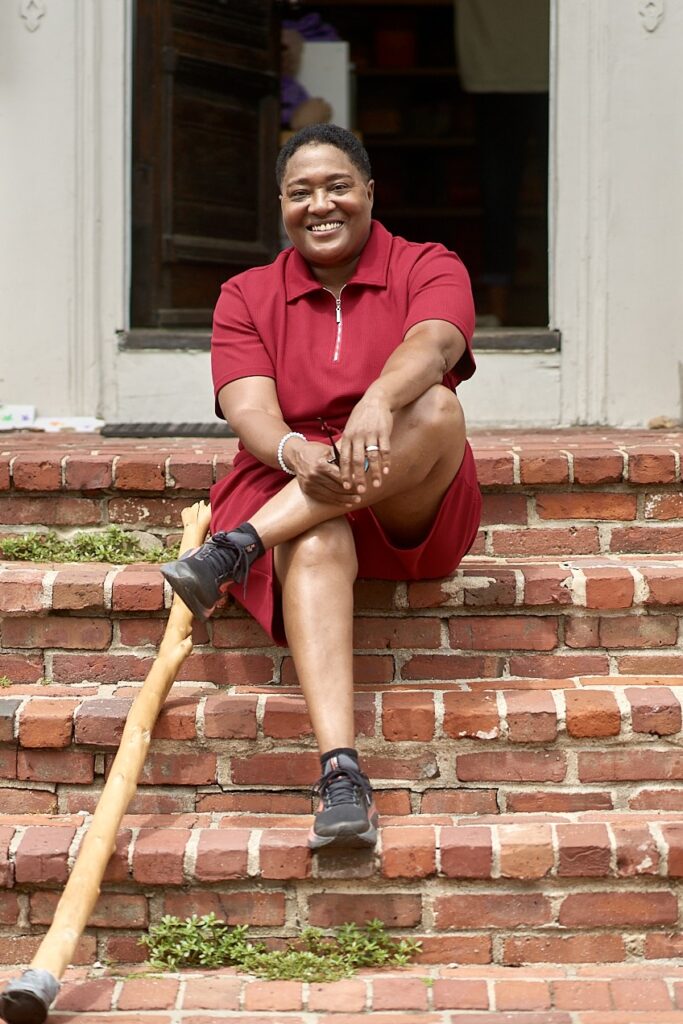
We spoke to Stacey (she/her) via video call while she was in Boston, MA on July 6, 2026 (her portraits were taken earlier in Provincetown, MA). She served in the Air Force from 1986 to 1991 as a law enforcement officer, and she was honorably discharged as an E-5 Sargent. Stacey enlisted after she lost her college scholarship, hoping that the military would enable her to continue her education.
Stacey told us that she knew from an early age that she was gay, and she started dating girls at 17. Queerness was not accepted by her family, community, or religion, which forced her to develop a well-honed practice of hiding early in life. When she entered the Air Force at a time when homosexuality was explicitly prohibited, she was not surprised that no one was out in basic training. She eventually connected with other queer people through “vibes,” remembering that it happened covertly when “you’re looking at each other’s eyes, and the eyes are starting to say it.” Yet she remained keenly aware that she had to continue hiding her sexuality in the military in order to protect herself and those around her. “Getting caught was always in your my mind,” she said. “They were always looking for us.”
Stacey had to make a lot of compromises to keep herself safe in the Air Force. She tempered her style of dress, cut ties with friends when they were investigated by the Office of Special Investigations, and sometimes dated men to divert attention from her identity. After her deployment to the Gulf War, she decided to separate from the military because she was tired of living a life of hyper-vigilence that made her feel “like you’re an undercover spy.”
Today, Stacey lives as an out gay woman in Boson, MA with her second wife and daughter. When she thinks back to her service, she told us that her recollections are dotted with “some good memories and some bad memories.” On the one hand, she values the opportunities she had to meet people, travel, and learn new skills. On the other, she is angered that she could not take college classes, choose her profession, or receive support for PTSD or the transition into civilian life.